

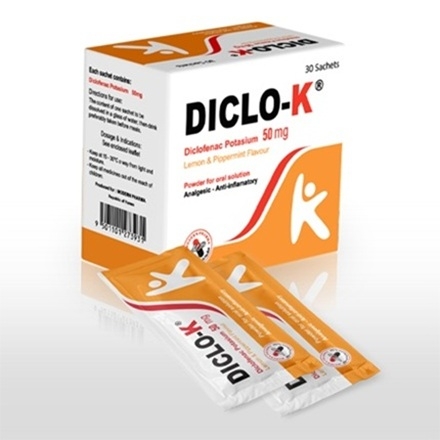
DICLO -K

DICLO -K

- Diclofenac Potassium, a phenylacetic acid derivative, is a non-steroidal compound with pronounced antirheumatic, anti-inflammatory, analgesic and antipyretic properties. 
- It inhibits prostaglandin biosynthesis which plays a major role in causing inflammation, pain and fever. Medication with Diclofenac Potassium can relieve the symptoms of inflammation, but can not cure the cause. 
- In rheumatic diseases, Diclofenac Potassium elicits a clinical response characterized by marked relief from signs and symptoms such as pain at rest, pain on movement, morning stiffness, and 
   swelling of the joints, as well as by an improvement in function. 
- Diclofenac Potassium is almost completely absorbed. Food has no clinical relevant influence on the  absorption and bioavailability of Diclofenac Potassium. 
- No accumulation occurs provided the recommended dosage intervals are observed even in patients suffering from renal impairment. 
- 99.7% of  Diclofenac Potassium  is bound to serum proteins. It enters the synovial fluid, and reaches higher levels in the synovial fluid than in the plasma and remain higher for up to 12 hours. 
- Diclofenac Potassium is subject to first-pass metabolism and then excreted mainly in the urine 
  (about 65%) but also in the bile (about 35%).

- Each Sachet of DICLO-K®  powder for oral solution contains: 
   Diclofenac Potassium     50 mg  
 

- Peptic and gastric ulcer, hypersensitivity to the components and other substances chemically
  strictly correlated to them and in particular hypersensitivity to aspirin .   
- DICLO-K® is contraindicated in patients  in whom attack  of asthma, urticaria  or acute rhinitis are precipitated or worsened by aspirin or other NSAIDs
- DICLO-K®is also contraindicated in children less than 14 years age.

-  when given concomitantly with preparations containing digoxin or lithium, DICLO-K® may increase their plasma concentrations. 
- Many NSAIDs are capable of inhibiting the activity of diuretics concomitant treatment  with 
  potassium-sparing diuretics may be associated with increased serum potassium level,thus these 
  should necessarily be checked regularity.
- Although no data in clinical investigations suggested that  DICLO-K®could have anticoagulant effect, there have been isolated reports of an increased risk of haemorrhage in patients receiving 
-  DICLO-K® and an anticoagulant therapy concomitantly. Close monitoring of such as patients is therefore  recommended.
- Like other NSAIDs, DICLO-K® at high dosage (200mg) may  temporarily inhibit platelet    aggregation.
- Clinical studies have shown that Diclofenac  can be given together with oral antidiabetic agents 
  without influenceing their clinical effect .However there have , been isolated reports of both 
  hypoglycemic and hyperglycemic effect during treatment with DICLO-K®, necessitating changes in the anti diabetic drug dosage.
-Special caution is required when NSAIDs are administered less than 24 hours before treatment with methotrexate, as blood concentrations of methotrexate can rise , increasing its toxicity.
- The effects of NSAIDs on renal prostaglandins may increase  the nephrotoxicity of cyclosporine.
 

- During pregnancy, DICLO-K® may be administrated only after careful evaluation of risk/ benefit analysis and in any case, with the lowest effective dose. 
- DICLO-K® may not be used during the third trimester of pregnancy owing to possibility of  
  delaying delivery and slackening labour it is necessary to underline the risk of hemorrhage that can arise from administration of NSAIDS during the terminal phase of pregnancy.
-After oral doses of 50mg every 8hours, DICLO-K® excreted in breast milk is so small that adverse effects in the neonate are unlikely.

- DICLO-K® is generally well tolerated. The most common side effects include  disturbances like nausea, vomiting, diarrhea, abdominal cramps, dyspepsia, flatulence, anorexia, peptic ulcer

 As with other NSAIDs, DICLO-K® should be used with caution:
- In patients with impaired hepatic or renal function.
- History of cardiovascular diseases and  peptic ulcer.

 - DICLO-K® 50 mg / sachet:
   Pack of  30 sachets  

 - Keep  at 15 - 30oC.
- Protect from moisture and light.