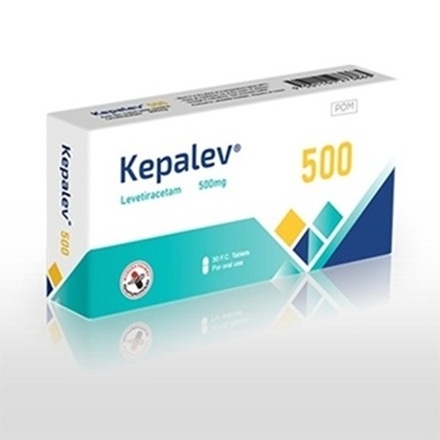
Kepalev 500 mg

Kepalev 500 mg

- Levetiracetam is a medication that belongs to a class of medicines called
  “antiepilepticts”. It is usually used as adjuvant therapy to treat multiple types of 
  seizures (abnormal electrical conductions in the brain) in children and adults.

 Each film coated tablet of  Kepalev® 500 mg contains:
  Levetiracetam                            500 mg   
- Each film coated tablet of  Kepalev® 250 mg contains:
  Levetiracetam                            250 mg 
- Each 1ml  of  Kepalev® Solution contains:
  Levetiracetam                            100 mg   

If you are allergic to levetiracetam, pyrrolidone derivatives or any of the other  
  ingredients of this medicine.
 

 -Probenecid:
  Probenecid, a renal tubular secretion blocking agent, has been shown to inhibit the renal 
  clearance of the primary metabolite, but not of levetiracetam. Nevertheless, the 
  concentration of this metabolite remains low.
- Methotrexate:
  Concomitant administration of levetiracetam and methotrexate has been reported to 
  decrease methotrexate clearance,resulting in increased/prolonged blood methotrexate 
  concentration to potentially toxic levels. Blood methotrexate and levetiracetam levels 
  should be carefully monitored in patients treated concomitantly with the two drugs.
- Laxatives:
  There have been isolated reports of decreased levetiracetam efficacy when the osmotic 
  laxative macrogol has been concomitantly administered with oral levetiracetam.  
 Therefore, macrogol should not be taken orally for one hour before and for one hour after 
  taking levetiracetam.
- Food and alcohol:
  The extent of absorption of levetiracetam was not altered by food, but the rate of 
  absorption was slightly reduced.

- If you are pregnant or breastfeeding, think you may be pregnant or are planning to have 
  a baby, ask your doctor for advice before taking this medicine. Kepalev® can be used
  during pregnancy, only if after careful assessment it is considered necessary by your 
  doctor. You should not stop your treatment without discussing this with your doctor.
-  A risk of birth defects for your unborn child cannot be completely excluded.
- Breast-feeding is not recommended during treatment.

- Although it may be rare, some patients may experience undesirable side effects when
  taking a medication. Tell your doctor or get medical help if you have any of the 
  following signs or symptoms:
- The most frequently reported side effects are nasopharyngitis, somnolence
  (sleepiness), headache, fatigue and dizziness. At the beginning of the treatment or at 
  increased dose side effects like sleepiness, tiredness and dizziness may be more 
  common. These effects should however decrease over time.
- Very common:
- Nasopharyngitis.
- Sleepiness, headache.
- Common:
- Anorexia (loss of appetite).
- Depression, hostility or aggression, anxiety, insomnia, nervousness or irritability.
- Convulsion, balance disorder (equilibrium disorder), dizziness (sensation of 
  unsteadiness), lethargy (lack of energy and enthusiasm), tremor (involuntary 
  trembling).
- Vertigo (sensation of rotation);
- Cough.
- Abdominal pain, diarrhoea, dyspepsia (indigestion), vomiting, nausea.
- Rash.
- Asthenia/fatigue (tiredness).
Uncommon:
- Decreased number of blood platelets, decreased number of white blood cells;
- Weight decrease, weight increase.
- Suicide attempt and suicidal ideation, mental disorder, abnormal behaviour,
  hallucination, anger, confusion, panic attack, emotional instability/mood swings, 
  agitation.
- Amnesia (loss of memory), memory impairment (forgetfulness), abnormal 
  coordination/ataxia (impaired coordinated movements), paraesthesia (tingling), 
  disturbance in attention (loss of concentration).
- Diplopia (double vision), vision blurred.
- Elevated/abnormal values in a liver function test.
- Hair loss, eczema, pruritus; muscle weakness, myalgia (muscle pain), injury.


Talk to your doctor or pharmacist if you develop allergic reactions such as shortness of 
  breath, skin rash, swelling of the face or neck, decreased blood pressure and dizziness.
- Do not stop your medication without consulting your doctor. Abrupt discontinuation of  this medication may worsen your convulsions. Dose should be gradually decreased.
- Contact your doctor if you experience unusual changes in behavior or mood, 
  appearance or worsening of depression, suicidal thoughts, excessive drowsiness or
  fatigue and weakness.
- Contact your doctor if you experience liver problems like dark urine, feeling tired, not 
  hungry, stomach pain, light-colored stools, throwing up, or yellow skin or eyes.
- This medication may cause blood problems such as neutropenia (Low number of
  neutrophils, neutrophils are responsible for fighting infections caused by bacteria), a 
  decrease in red blood cells and in heamoglobin.
- If you suffer from kidney problems, follow your doctor’s instructions. He/She may 
  decide if your dose should be adjusted.
- If you notice any slowdown in the growth or unexpected puberty development of    
  your child, please contact your doctor.
- If you have a family or medical history of irregular heart rhythm (visible on an electrocardiogram), or if you have a disease and/or take a treatment that make(s) you prone to heartbeat irregularities or salt imbalances.
- If stopping treatment, Kepalev® should be discontinued gradually to avoid an increase of 
  seizures. Should your doctor decide to stop your Kepalev® treatment, he/she will instruct
  you about the gradual withdrawal of Kepalev®.   

- Bottle of 100 ml Oral solution.
- Blister of 10 tablets, pack of 3 blisters.  
 

- Store in a dry place, at temperature below 25º C.